
Gibraltar and Spain end border checks
A new era began between Spain and the tiny British territory of Gibraltar on Wednesday, as border checks that have long been a source of tension and frustration were finally lifted.
An AFP journalist at the frontier said several dozen people and vehicles crossed the border from Spain for the first time without undergoing customs checks a few minutes after midnight.
READ MORE: No borders and new taxes - What changes in Gibraltar on July 15th?
Several hundred people gathered for the occasion, waving Spanish flags, while Gibraltar's Chief Minister, Fabian Picardo, announced: "Europe is back."
Gibraltar, a self-governing British territory at the southernmost tip of the Iberian peninsula, is home to only about 40,000 people but relies on some 15,500 workers who cross from Spain every day.
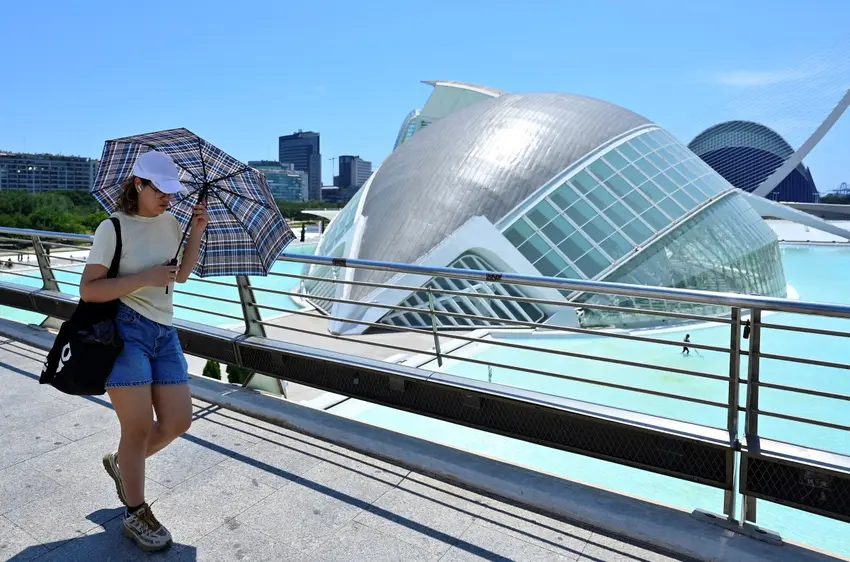
Zaragoza and Valencia on red alert for heat today
Spain's national weather agency Aemet has issued a red alert for extreme heat in the provinces of Zaragoza and Valencia for Wednesday, with maximum temperatures expected to reach 42 degrees Celsius.
It's expected to be particularly hot along the southern coast of Valencia and in the Ebro River basin in Zaragoza province.
With the arrival of the 'dog days' of summer (the period of the year with the highest temperatures), Aemet has classified this heat as an extraordinary danger.
READ ALSO: What Spain's different heat alerts mean and how to act in each case
Other regions in Spain will also be affected as temperatures are expected to be "significantly" high across the Iberian Peninsula in general.
There will also be Saharan dust in the atmosphere (called calima), making it feel even more suffocating.
Aemet has also issued orange heat alerts for the provinces of Albacete, Alicante, Almería, Barcelona, Castellón, Girona, Granada, Huesca, Lleida, Murcia, Tarragona, Teruel, Valencia, Zaragoza, and the island of Mallorca, where highs are expected to reach between 37C and 42C.
Spain tourism revenue rises as visitors spend more
Tourism revenue rose in Spain in the second quarter of 2026, with the country benefiting from its reputation as a safe destination as Middle East tensions persisted and an increase in spending per person, tourism industry group Exceltur said on Tuesday.
Tourism-related gross domestic product is expected to grow by 2.7 percent over the full year, after rising 3.4 percent in the second quarter as foreign arrivals increased.
Spain benefited from a reorientation of tourist flows linked to the conflict in the Middle East, as visitors were drawn by the country’s reputation as a safe destination, the group said.
READ ALSO: Do Spaniards really want 100 million yearly tourists?
"We expect this effect to continue, at least this year," Exceltur’s vice-president Oscar Perelli told a news conference, saying the uncertainty has "intensified again" in the wake of renewed strikes by the US and Iran.
Tourist revenues were boosted by the rise in arrivals and higher spending per visitor.
Foreign tourist spending rose 8.2 percent in the second quarter compared with the same period last year, while Spanish residents increased their domestic tourism spending by 8.3 percent.
The figures also reflected an upmarket shift in tourism, with Spaniards increasingly choosing higher-end accommodation.
Overnight stays at four- and five-star hotels rose 3.6 percent, according to Exceltur data.
The group forecast a "positive summer" for tourism businesses, with sales expected to rise 3.2 percent, although it warned the rise in energy costs due to the Middle East conflict could weigh on the outlook.
Spain, the world's second-largest tourism destination by visitor numbers, welcomed a record 96.8 million foreign visitors last year. Nearly half, 45 percent, came from Britain, France and Germany.
86-year-old Brit among injured at Spain's San Fermín bull runs
Ten men suffered injuries Tuesday during the eighth and final bull run of Spain's famed San Fermín festival, bringing to 57 the total number of daredevils injured during this year's fiesta.
An 18-year-old man suffered a gore wound to the thigh and a 46-year-old man was gored in the chest, while the remaining eight were taken to hospital with bruises of varying severity, the Navarre regional government said in a statement.
Among these injured was an 86-year-old British man who suffered injuries to his hand.
The bulls completed the 848.6-metre (928-yard) course from a holding pen to the city bull ring in two minutes and 25 seconds.
Each morning for eight days, hundreds of daredevils, many wearing traditional white shirts with red scarves tied around their necks, tested their bravery by running ahead of a pack of bulls through the narrow, winding streets of the medieval city. The vast majority are men.
The bulls face almost certain death in afternoon bullfights featuring Spain's top matadors.
The San Fermín festival, which was made famous by Ernest Hemingway's 1926 novel "The Sun Also Rises", draws people from around the world.
Four men who took part in this year's bull runs were gored, including a 30-year-old Spanish man who was pierced by a horn in the face.
Five of the 57 injured are foreign nationals: two Britons, an Australian, an American and a German who was gored in his left arm.
Although the runs are over, the festival's closing ceremony will take place at midnight (2200 GMT).
Sixteen people have been killed in the bull runs since records started in 1911. The last death was in 2009 when a bull gored a 27-year-old Spaniard in the neck, heart and lungs.
With additional reporting by Alex Dunham.
Comments